nextnano v2026.7 Focusing on the calculation of band structures, quantum transport, and optoelectronic properties of quantum-scale devices, it is widely recognized as the best-in-class commercial tool for simulating quantum cascade lasers (QCLs).
Based on quantum mechanical methods (Schrödinger’s equation, Poisson’s equation, and the continuous current equation), this software uses self-consistent calculations to study the electronic and optical properties of nanoscale semiconductor devices. It is a TCAD simulation tool widely used in academia and by compound semiconductor companies.
Core Modules
The nextnano product line includes multiple components that cover the full range of simulation needs, from steady-state to non-steady-state conditions:
nextnano++: A general-purpose steady-state simulation engine for calculating band structures, strain, and electrostatic properties, covering static device analysis of quantum wells, wires, and dots, LEDs, power HEMTs, and more
nextnano3: A 3D nanodevice simulator supporting three-dimensional simulations of structures such as quantum dots, quantum wires, RTDs, MOSFETs, and HEMTs
nextnano.NEGF: A quantum transport solver based on the non-equilibrium Green’s function (NEGF/Keldysh), specifically designed to handle non-equilibrium carrier transport and optoelectronic coupling effects under applied bias; it is the benchmark tool for QCL simulation in the commercial sector
nextnano.QCL: A simulation module specifically designed for quantum cascade lasers
nextnano.MSB: A quasi-equilibrium quantum transport calculation module
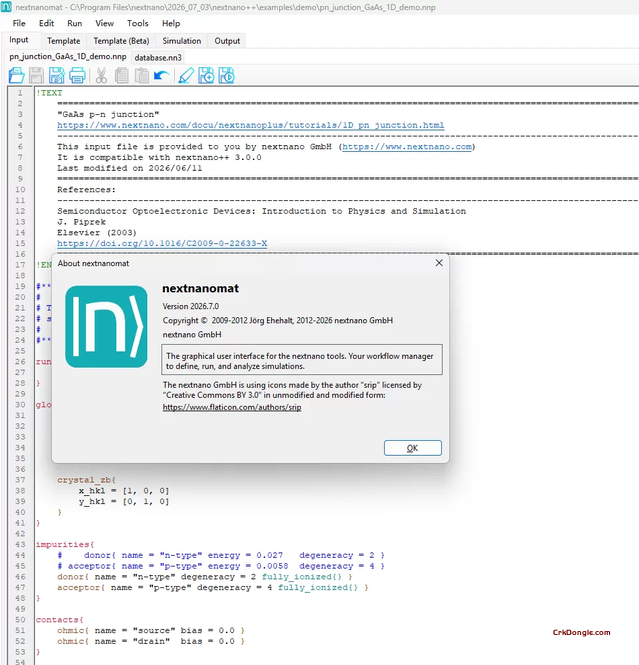
nextnanomat: A graphical user interface (GUI) that integrates modeling, job submission, and post-processing, supporting 1D/2D/3D visualization
nextnanopy: A Python interface library supporting batch simulations, parameter sweeps, and secondary data analysis