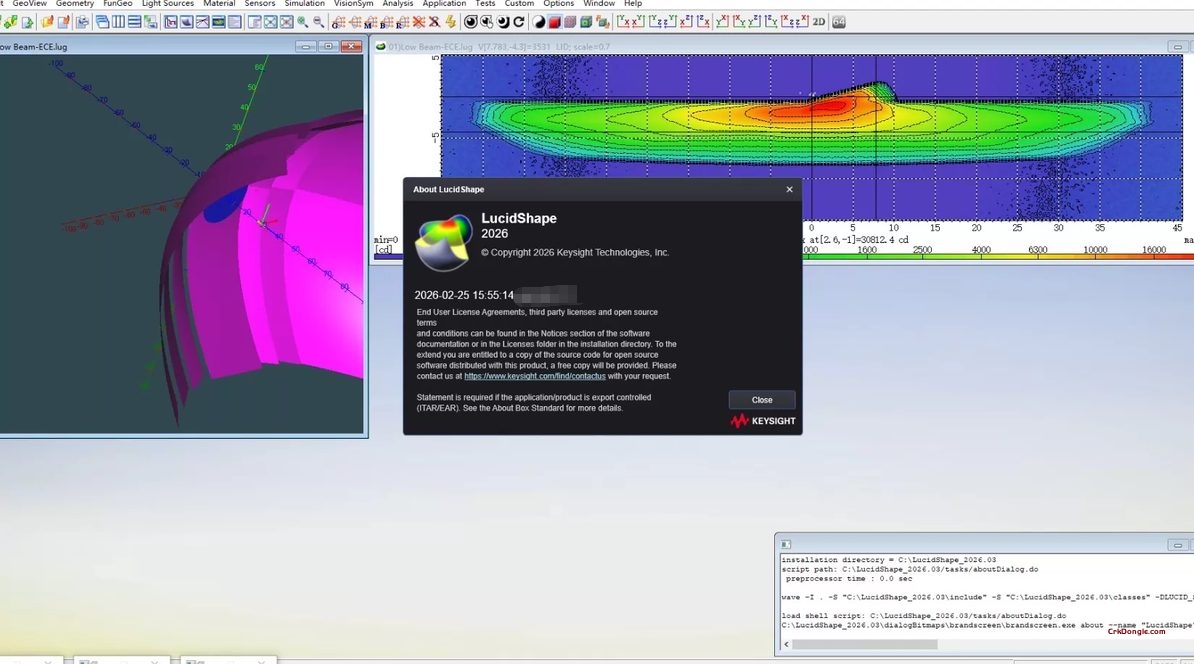
LucidShape 2026 is the latest release of Synopsys’ industry-leading software for computer-aided design, simulation, and analysis of automotive lighting systems. Trusted by automotive OEMs and Tier 1/2 suppliers worldwide, it enables engineers to design, simulate, and validate headlamps, taillights, signal lights, and interior lighting before physical prototyping.
What’s New in LucidShape 2026
VisionSym Integration
New interoperability with VisionSym allows optical models built in LucidShape to be visualized using GPU-accelerated, photometrically accurate Monte Carlo rendering. This enables combined lit and unlit appearance evaluation for comprehensive design validation.
Light Source Apodization Workflow
Converts measured ray files into spatial and angular Light Intensity Distribution (LID) data, reducing noise in luminance and near-field analyses while enabling reusable, high-fidelity source models for consistent simulation accuracy.
Spectral Power Distribution Export
New SPD export capability allows combined spectral data from spectral LIDs to be saved in reusable ASCII format. This supports consistent color behavior across simulations and streamlines evaluation of mixed-emitter white light sources and color targets.
Regulatory & Benchmark Updates
Expanded coverage for global automotive lighting standards including ECE, SAE, and JIS regulations, reducing manual setup time and enabling earlier compliance assessments during the design phase.
Luminance Clipping for HDR
New luminance clipping functionality for HDR image comparison, enabling more accurate evaluation of high dynamic range lighting scenarios and improved visual quality assessment.
Automation & Scripting
Enhanced Script Gallery for improved automation workflows, reducing design cycle time and supporting more efficient convergence on appearance, uniformity, color, and regulatory requirements.
Collimator & Mini-Pillow Editing
Expanded modeling control with improved collimator and mini-pillow editing capabilities, including full CSV round-trip editing for seamless data exchange with external tools.
Core Features
LucidStudio Interactive Environment
Complete interactive development environment for executing all design tasks, displaying and analyzing geometry, and reviewing simulation results with intuitive navigation and real-time feedback.
LucidShape FunGeo
Collection of algorithms to calculate functional geometry such as freeform reflectors and lenses based on the principle that form follows function. Specify intended lighting parameters and the program calculates the required geometry, minimizing stray light and maximizing flux collection.
LucidShell Scripting
C-like script interpreter providing freedom to customize and create custom applications, automate repetitive tasks, and build complex lighting simulations programmatically.
LucidObject Component Library
Rich toolbox of lighting components including predefined materials, media, volume scatter, and BSDF data to simplify and speed the process of building complex lighting simulations.
Visualize Module
High-speed photorealistic visualization of automotive lighting system’s lit and unlit appearance. Physically accurate diagnostic tool depicting all interactions between system geometry and light sources for human eye perception evaluation.
Monte Carlo Ray Tracing
Multiple simulation modes including forward Monte Carlo, spectral ray trace, multi-processor ray trace, accurate NURBS ray trace, fast triangle intersection, and interactive ray trace for different precision and speed requirements.
Light Data Analysis
Comprehensive analysis tools including measurement tables for ECE/SAE/JIS regulations, light data operations (gradients, filter, addition, subtraction, scale, mirror), CIE TC4-45 headlamp benchmark, and comparison between simulation and hardware measurement data.
LucidDrive Virtual Night Driving
Real-time virtual night-driving simulations generating realistic lighting scenes for quick and accurate evaluation of beam patterns on roads, traffic signs, and surroundings prior to expensive fabrication and testing.