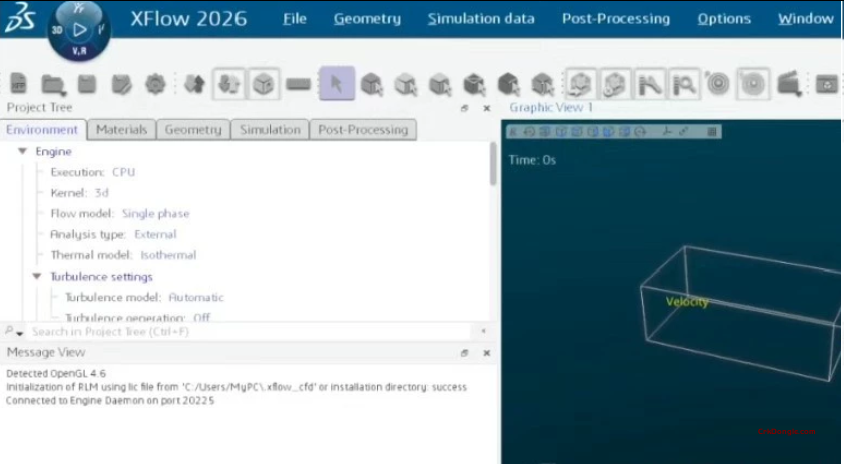
SIMULIA XFlow 2026: Meshless Lattice-Boltzmann CFD Simulation Software
SIMULIA XFlow 2026 is a high-fidelity Computational Fluid Dynamics (CFD) solver from Dassault Systèmes, delivered as part of the R2026x release cycle. It is based on particle-based Lattice-Boltzmann (LBM) technology and uses a meshless approach to simulate complex flows and their interactions.
Linux Platform Support
XFlow 2026 officially supports 64-bit Linux operating systems and provides full GPU computing support on Linux, compatible with NVIDIA GPUs (and AMD GPUs on Linux in some configurations).
Operating System Requirements: Minimum CentOS 7 / RHEL 7 / SUSE 12 / Ubuntu 13.04, with glibc >= 2.17. Newer documentation indicates Linux support upgraded to CentOS 7 and above; using a more recent distribution is recommended.
GPU Computing Requirements (Linux):
-
NVIDIA GPU: CUDA Driver >= 450.80.02
-
AMD GPU: Requires
export LD_LIBRARY_PATH=/opt/rocmlib:$LD_LIBRARY_PATHand OpenMPI 4.1 + UCX 1.13.0 for multi-GPU parallelization
Core Functional Features
Meshless Solving and Automatic Lattice Generation
XFlow uses a particle-based LBM method, avoiding traditional CFD meshing workflows. Its automatic lattice generation and adaptive refinement minimize user input, making surface complexity no longer a limiting factor.
Turbulence Simulation
XFlow 2026 does not use traditional RANS-type models (k-ε, k-ω, SST). Instead, it relies on Implicit Large Eddy Simulation (iLES) as its core, using LBM’s inherent numerical dissipation and grid resolution to naturally truncate turbulence scales. Two explicit subgrid-scale models are optionally available:
-
Smagorinsky: Algebraic LES model suitable for medium-Re separated flows
-
WALE: Gradient-type LES model that suppresses near-wall over-dissipation, suitable for complex boundary layers
Multiphase Flow and Moving Parts
Supports true moving geometries, complex multiphase flows, and free-surface simulations, specifically oriented toward lubrication workflows (gearboxes, electric drives, etc.), enabling prediction of wetted area, churning losses, and other results difficult to measure experimentally.
GPU Acceleration and Multi-Resolution
Provides comprehensive GPU computing support for significantly accelerated solving. Multi-resolution technology supports multi-geometry-detail simulations. Surface fields such as heat transfer coefficients can be output on moving geometries, with transient or averaged value saving to reduce storage requirements.