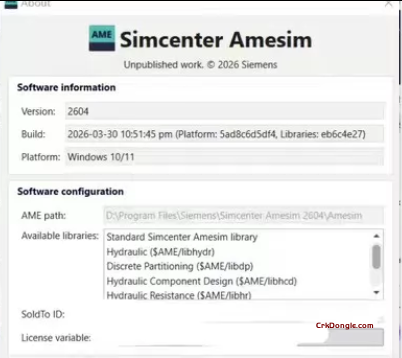
Simcenter Amesim 2604 is the latest release of the world-leading 1D multi-physics system simulation platform, developed by Siemens Digital Industries Software. Designed for mechanical, electrical, and systems engineers, Amesim enables users to model, simulate, and optimize complex mechatronic systems—from fluid power and thermal management to propulsion and electrification—before building physical prototypes. The 2604 release marks a significant leap forward in battery design automation, gas system modeling, and workflow integration across the Simcenter portfolio.
The platform provides an advanced, open, and user-friendly environment for assessing and optimizing system performance. Its comprehensive multi-physics libraries, validated components, and industry-specific solutions allow engineers to create accurate virtual prototypes quickly, while its open architecture supports seamless integration with 1D and 3D CAE tools for model-in-the-loop (MIL), software-in-the-loop (SIL), and hardware-in-the-loop (HIL) applications.
Key Features
- Battery Pack Assistant – Six Major Upgrades – Delivers a major boost for battery pack engineers:
- Simcenter Simlab Integration: Import 3D models directly from Simcenter Simlab into the Battery Pack Assistant, eliminating manual geometry rebuilding between structural and thermal workflows.
- Non-Conformal Interfaces: Model flexible cooling layouts with mismatched grids, supporting offset cooling plates, irregular contact surfaces, and multi-layer thermal systems without sacrificing accuracy.
- Automated Side Cooling Setup: A guided workflow automatically arranges, connects, and thermally couples side-cooling components, accelerating design exploration.
- 30x Faster Schematic Generation: Schematic creation that previously took minutes now completes in seconds, enabling rapid iteration of cell arrangements and configurations.
- Composite Electrode Modeling: Define multiple active materials within a single electrode for both Single Particle with Electrolyte (SPMe) and pseudo-2D (P2D) electrochemical models, with independent aging modeling for each material.
- SOC-Dependent Thermal Runaway: The enhanced thermal runaway model captures how runaway behavior varies with state of charge, reducing the need for manual kinetics tuning and physical safety testing.
- Expanded Gas Systems Capabilities – The Gas库 receives three major upgrades, including a compressor map migration tool. The library also supports mixed-gas condensation modeling, which is useful for industrial pneumatics, HVAC compressors, and specialized gas handling in extreme environments.
- Vector Ports & FMU 3.0 Support – Platform interfaces now support vector ports, allowing a single connection to carry multiple physical quantities. FMU export also supports vector ports under the FMU 3.0 standard, improving co-simulation with external tools.
- EV Modeler – Automated Vehicle Thermal Management – The new Electric Vehicle Modeler (available via the App Space) automatically generates complete EV models:
- Supports single-, dual-, triple-, and quad-motor architectures in front-, rear-, or all-wheel drive layouts (up to 8 combinations).
- Offers both 1D and 15-DOF vehicle dynamics options.
- Optionally enables thermal management coupling for motors, battery, and power electronics, along with built-in driver cycles such as WLTC.
- Aircraft Fuel System Enhancements – Adds new components and a friction-aware piping sub-model, plus a case that auto-generates complex fuel systems with multiple interconnected tanks from a sketch.
- Improved CAD Interoperability – Supports NX pipeline drawings and STEP file import for piping systems, expands native CAD format support (CATIA, SolidEdge), and automatically detects the number of fluids and thermal surfaces in imported fluid applications.