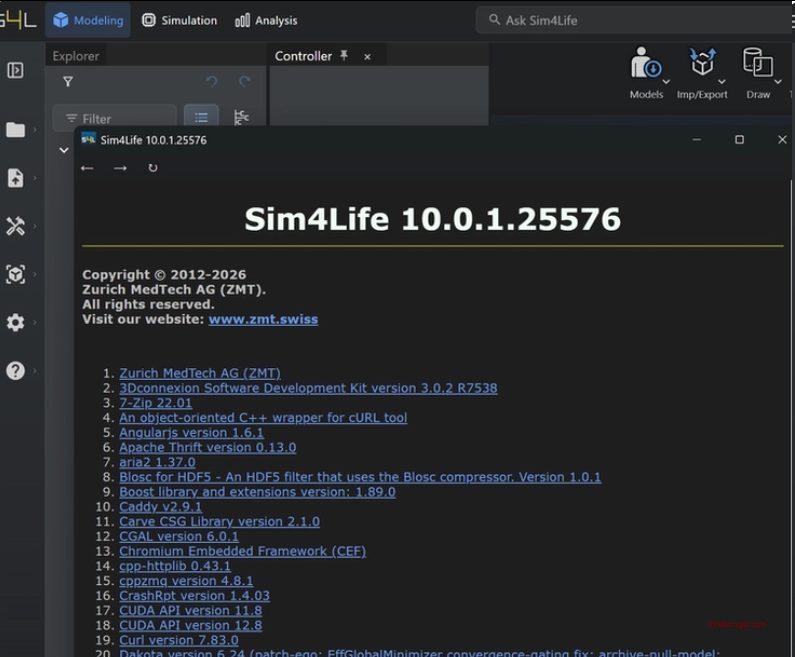
Sim4Life V10.0 is the latest major release from ZMT Zurich MedTech. It expands the platform from single-neuron modeling to whole-brain network dynamics, introduces an AI-powered “Text-to-Simulation” assistant, and delivers a unified desktop/web interface with localization in four languages .
Key New Features in V10.0
BraiNN: Ultra-Fast Whole-Brain Dynamics & Virtual EEG Lab
BraiNN represents the brain as a network of neural mass models connected by personalized structural connectivity. Stimulation fields from Sim4Life’s low-frequency solvers drive the network, while lead fields from the same head model project activity onto simulated scalp EEG . Benchmark tests show BraiNN runs over 90× faster on GPU than The Virtual Brain on CPU, making parameter sweeps and stimulation optimization feasible on a single workstation . A ready-to-run brain and head model built from open-access imaging data ships with V10.0 .
AI Assistant & Text-to-Simulation
The AI Assistant generates Python scripts from natural-language instructions (e.g., “build this geometry,” “set up this simulation,” “extract these results”). It determines required steps, writes the script, explains its reasoning, and keeps the script open for inspection and adjustment . It is trained on the workflows and QA steps used by ZMT’s physics, neuroscience, and biomedical teams .
ThermoReg: Whole-Body Thermoregulation
A new simulator implementing the UTCI-Fiala multi-node model of human heat transfer and temperature regulation. It captures compartmental heat transport, counter-current exchange, respiration, sweating, shivering, and vasoconstriction/dilation. Coupled with Sim4Life’s EM and acoustic modeling, it addresses MRI safety, thermal therapies, 5G exposure, and heat stress applications .
Unified Interface & Localization
The refreshed interface is shared between desktop and web platforms, featuring a modern scripting environment, integrated search, and guided modeling operations. Sim4Life Classic V10.0 remains available and fully supported alongside the new interface . AI-supported localization covers menus, tooltips, dialogs, and error messages in English, Korean, Chinese, and Spanish at launch .
Low-Frequency Solver Enhancements
Low-frequency solvers now compute current fluxes to build the admittance/impedance matrix directly, accelerating post-processing. A new universal current normalizer adds robustness and flexibility in boundary condition choice, supporting multipolar exploration and downstream neural-response analysis .