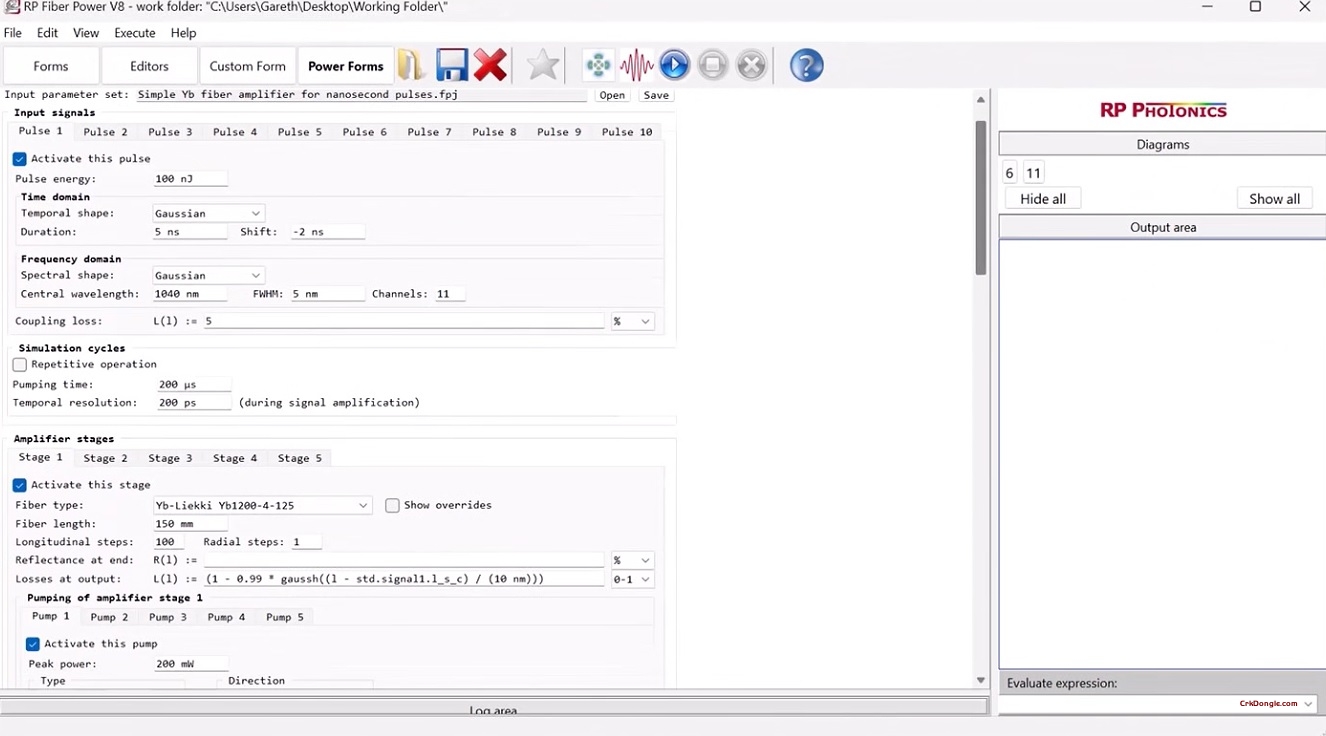
RP Fiber Power 8: The Integrated Simulation Suite for Advanced Fiber Optics
RP Fiber Power 8 is a highly specialized, industry-respected software environment dedicated to the modeling and design of fiber-optic devices and systems. It provides optical engineers and researchers with a powerful, script-based platform to simulate the intricate physical interactions within fiber lasers, amplifiers, and passive components. By solving the underlying differential equations that govern light propagation, amplification, and nonlinear effects, RP Fiber Power 8 enables the virtual prototyping and optimization of high-performance fiber devices, reducing the need for costly and time-consuming experimental trials.
Core Philosophy: From Physical Principles to Device Performance
The software’s strength lies in its rigorous, physics-first approach. Users define their system—including fiber parameters (doping profiles, geometry), pump and signal sources, and cavity configurations—through a flexible scripting language or graphical forms. The software then computes the detailed evolution of optical powers, optical spectra, and gain spectra along the fiber, providing deep insight into performance limits and design trade-offs that are difficult to obtain experimentally.
Key Application Areas & Simulation Capabilities:
1. Fiber Amplifier & Laser Design
-
Doped Fiber Amplifiers: Models erbium-doped fiber amplifiers (EDFAs), ytterbium-doped amplifiers (YDFAs), and other rare-earth-doped systems with high accuracy, including effects like excited-state absorption and energy transfer.
-
Fiber Laser Modeling: Simulates continuous-wave (CW), pulsed (Q-switched, mode-locked), and multi-stage laser oscillators. Calculates output power, threshold, efficiency, and temporal/spectral characteristics.
-
Power Scaling & Thermal Effects: Models high-power systems where thermal lensing and quenching effects become critical.
2. Comprehensive Nonlinear Optics Modeling
-
Nonlinear Pulse Propagation: Simulates complex nonlinear effects using the generalized nonlinear Schrödinger equation (GNLSE), including self-phase modulation (SPM), cross-phase modulation (XPM), four-wave mixing (FWM), and stimulated Brillouin/Raman scattering (SBS/SRS).
-
Supercontinuum Generation: A key application for modeling the extreme spectral broadening of ultrashort pulses in nonlinear fibers.
-
Soliton Dynamics: Models the formation and propagation of optical solitons in anomalous dispersion regimes.
3. Advanced Passive & Active Component Analysis
-
Propagation in Passive Fibers: Analyzes attenuation, dispersion, bending losses, and nonlinear effects in standard single-mode, multimode, and photonic crystal fibers.
-
Mode Solvers: Calculates fiber modes (LP modes, exact modes) and their properties (effective area, dispersion, cutoff) for arbitrary refractive index profiles.
-
Beam Propagation Method (BPM): Simulates light propagation in waveguides with longitudinally varying properties.
4. Flexible Scripting & Visualization
-
Powerful Scripting Language: While offering form-based input for common tasks, its full potential is unlocked through a Pascal-like scripting language, granting complete control over simulation parameters, iterative optimization loops, and custom analysis.
-
Advanced Graphical Output: Generates publication-quality 2D and 3D plots of powers vs. position, optical spectra, temporal pulse shapes, and more.