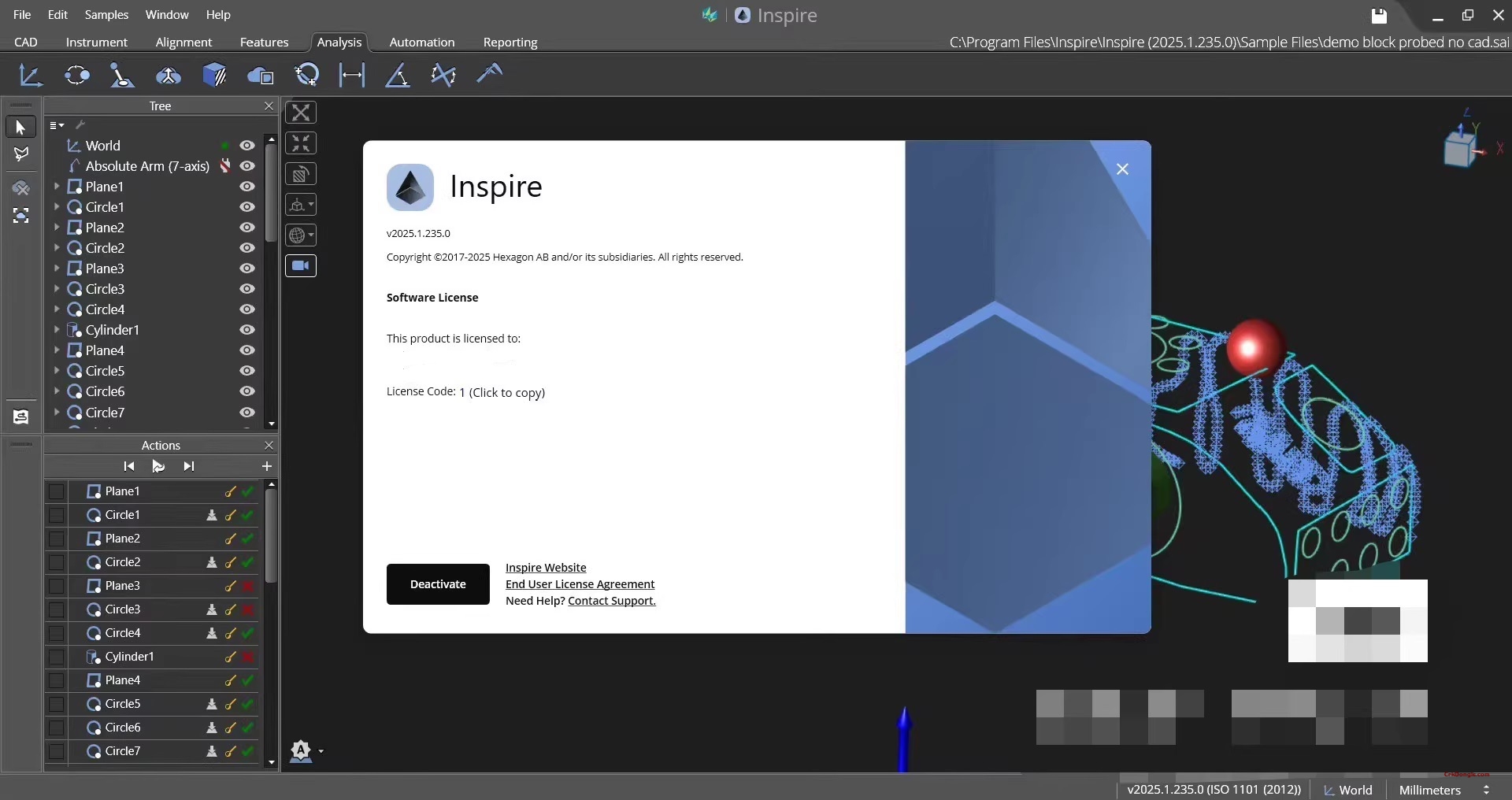
Hexagon Inspire v2025.1: The AI-Driven Generative Design & Process Simulation Powerhouse
The frontier of engineering design is shifting from crafting a single solution to exploring a universe of optimal possibilities. Hexagon Inspire v2025.1 stands at this frontier as a transformative computer-aided engineering (CAE) platform that fundamentally reimagines the product development workflow. Moving beyond traditional simulation’s role as a validation step, Inspire embeds AI-driven generative design and process simulation at the very heart of the conceptual phase. It empowers engineers and designers to define performance goals and manufacturing constraints, then leverages sophisticated algorithms to automatically generate and evaluate hundreds of design alternatives that are lightweight, structurally efficient, and ready for production. This version, v2025.1, represents the culmination of Hexagon’s vision for a unified environment where structural integrity, fluid dynamics, motion, and manufacturing feasibility are analyzed in concert, enabling a radical leap in innovation, material efficiency, and time-to-market for industries ranging from aerospace to consumer electronics.
Core Philosophy: From Human-Guided to AI-Assisted Creation
Hexagon Inspire is built on the principle of goal-driven, constraint-based design. Instead of manually modeling a part shape, engineers start by defining the “design space” (the volume the part can occupy), “preserved regions” (mounting points, interfaces), loads, constraints, and desired safety factors. Inspire’s solvers then computationally “grow” material only where it is needed to meet these objectives, resulting in organic, high-performance structures that often defy conventional intuition. This process, known as Topology Optimization, is seamlessly integrated with manufacturing process simulation (like casting or additive manufacturing) to ensure the generated designs are not just theoretically optimal, but also practically producible. This synergy defines the modern generative design workflow.
Key Features and Integrated Modules
1. Generative Design & Topology Optimization
This is the flagship capability that sets Inspire apart.
-
Goal-Based Optimization: Automatically generates the optimal material layout within a defined space to meet targets for stiffness-to-weight ratio, natural frequency, or stress limits.
-
Manufacturing Constraint Integration: Unique to Inspire is its ability to incorporate manufacturing methods directly into the optimization. It can enforce constraints for castability (draft angles, parting lines), extrudability (uniform cross-sections), and additive manufacturability (overhang angles, support minimization), ensuring the final design is ready for production.
-
PolyNURBS Conversion: Transforms the complex, mesh-based results of topology optimization into smooth, watertight, and editable CAD surfaces (PolyNURBS) that can be seamlessly exported to any major CAD software for detailed design and documentation.
2. Integrated Multi-Physics Simulation Environment
Inspire provides a unified suite of solvers, eliminating the need to transfer models between disparate analysis tools.
-
Structural Analysis: Performs linear static stress, normal modes (vibration), and buckling analysis to validate the performance of both generative and traditional designs.
-
Motion Analysis: Simulates the kinematics and dynamics of mechanisms, calculating forces, velocities, and accelerations, which can then be directly used as loads in a structural or topology optimization study.
-
Fluid Flow Simulation (with Inspire Flow): Models internal and external fluid flow, thermal management, and pressure drops, allowing for multi-physics optimization where thermal and structural requirements are balanced.
3. Advanced Process Simulation (Inspire Cast & Inspire Additive)
This module is critical for bridging the gap between design and manufacturing.
-
Casting Process Simulation: Predicts potential defects like porosity, shrinkage cavities, and cold shuts in metal castings. Engineers can virtually test and optimize gating systems, risers, and cooling rates to achieve high-quality cast parts right from the first mold.
-
Additive Manufacturing (3D Printing) Simulation: Accurately predicts and compensates for thermal distortion and residual stress inherent in metal 3D printing processes like DMLS or SLM. This allows for pre-deforming the digital model so that the printed part meets dimensional tolerances, saving immense time and cost in trial-and-error printing.
4. Intuitive, Modern User Interface & Workflow
-
Low Barrier to Entry: Designed to be accessible to both simulation experts and design engineers, with a modern ribbon interface, drag-and-drop setup, and real-time feedback.
-
Scenario Studies: Easily set up and run multiple “what-if” studies to compare the impact of different load cases, materials, or manufacturing methods on the optimal design.
Who Should Use Hexagon Inspire v2025.1?
This software is a game-changer for forward-thinking organizations and roles:
-
Product Design & R&D Engineers: In automotive, aerospace, and industrial equipment seeking to create breakthrough lightweight and high-performance components.
-
Simulation & CAE Specialists: Looking to integrate generative methodologies and process simulation into the early-stage design cycle.
-
Additive Manufacturing Engineers & Labs: Needing to simulate and compensate for 3D printing distortions to ensure first-time-right builds.
-
Foundry & Casting Engineers: Who want to digitally validate and optimize mold designs to reduce scrap rates and improve yield.
Conclusion
Hexagon Inspire v2025.1 is not merely an upgrade to existing CAE tools; it represents a paradigm shift towards a more intelligent, automated, and holistic design process. By placing AI-driven optimization and manufacturability analysis at the start of the design journey, it empowers engineers to create superior products that are lighter, stronger, and more cost-effective to produce. In an era defined by sustainability challenges and the need for rapid innovation, mastering a platform like Hexagon Inspire is no longer just a competitive edge—it is becoming an essential capability for any engineering organization that aims to lead its field. It turns the traditional “design, then analyze” model on its head, ushering in a future where the software itself becomes a co-creator in the engineering process.