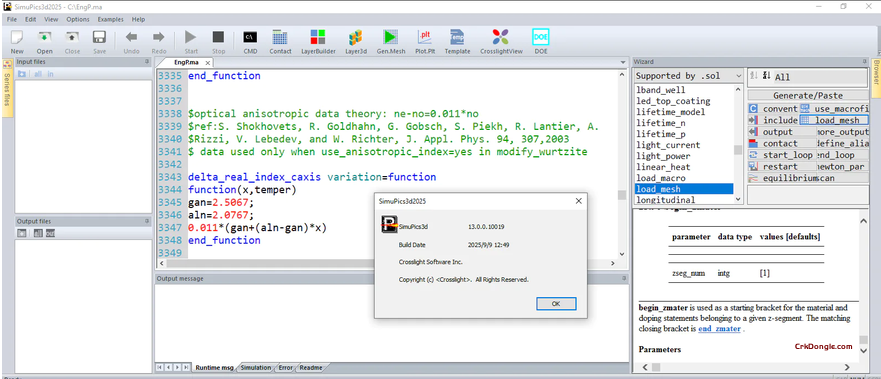
What’s New in PICS3D 2025
The 2025 stable release focuses on production-ready enhancements to existing models rather than introducing experimental features.
Enhanced PCSEL Modeling (2025 Beta)
The primary update in the 2025 beta is for Photonic Crystal Surface-Emitting Laser (PCSEL) simulation. It now allows for calculation of coupling coefficients using either a full 3D unit cell or a simplified 2D index profile generated from the 3D unit cell. This coupling information can then be used for complete device simulation using existing sliver models. Interested users should contact Crosslight directly for a demo.
Key Experimental Features in 2026 Beta (Not 2025 Stable)
The Photon-Photon Resonance (PPR) model has been implemented in the 2026 beta version only. This is a late addition that is not included in the 2025 stable release and is available for testing by customers with an active maintenance contract. The PPR model uses perturbation theory to introduce mode-mode interaction, enabling simulation of effects like modulation bandwidth enhancement in DBR lasers.
Core PICS3D Capabilities
PICS3D (Photonic Integrated Circuit Simulator in 3D) is a state-of-the-art 3D simulator for semiconductor lasers and related photonic devices. It couples 2D/3D semiconductor equations (drift-diffusion, Poisson) with optical modes in both lateral and longitudinal directions.
Supported Devices:
-
Edge-emitting lasers (FP, DFB, DBR, Broad Area)
-
Vertical cavity surface emitting lasers (VCSEL)
-
Semiconductor optical amplifiers (SOA) and superluminescent diodes (SLD)
-
Electroabsorption modulators (EAM) and waveguide photodetectors (WPD)
-
Quantum cascade lasers (QCL) and quantum dot lasers
-
Photonic crystal lasers, ring lasers, and hybrid lasers
Key Physical Models and Outputs:
-
Waveguide/grating coupling coefficients (1st and 2nd order)
-
Longitudinal carrier density, optical gain, and intensity for main/side modes
-
Surface emission mode distribution for 2nd-order grating DFB lasers
-
Side mode ratio, linewidth, effective alpha, second harmonic distortion
-
AM/FM small-signal modulation response, FM/RIN noise spectrum
-
Self-heating and thermal roll-over