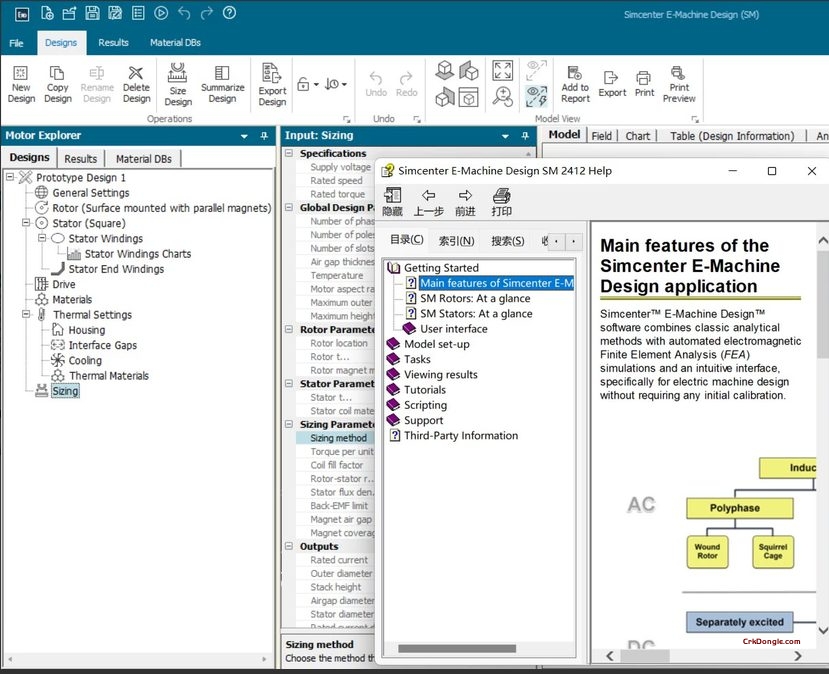
Simcenter E-Machine Design 2606 is the latest release of Siemens’ electric machine design simulation software, published June 21, 2026. This version focuses on expanding downstream simulation workflows and cross-tool model reuse, helping engineers transition more efficiently from motor design to electromagnetic, thermal, vibration, and drive system analysis.
Key New Features
Hairpin Winding Export to Downstream Simulation
Version 2606 significantly enhances hairpin winding motor design export capability, preserving winding definitions, end-winding geometry, and electrical connections into downstream simulation environments. Exported models include detailed 3D winding representations that can be used directly in Simcenter 3D for electromagnetic analysis or Simcenter STAR-CCM+ for thermal analysis — without manually rebuilding winding geometry.
Integrated Simcenter SPEED Induction Motor Analysis
Version 2606 integrates Simcenter SPEED induction motor analysis capabilities into E-Machine Design. Engineers can leverage proven analytical motor models to complete induction motor performance evaluations in seconds, enabling rapid exploration of numerous design alternatives in early development. Existing Simcenter SPEED induction motor models can be imported directly for model reuse.
Accelerated Vibration Synthesis Data Preparation
For the Electric Motor Vibration Synthesis (EMVS) module in Simcenter 3D, version 2606 improves the airgap flux density export workflow: electromagnetic solving is now parallelized, and unnecessary loss calculations can be skipped when generating EMVS datasets. This reduces preparation time for vibration synthesis inputs, enabling earlier noise and vibration assessment.
Reduced-Order Model (ROM) Export to Simcenter PSIM
Version 2606 extends model reuse into drive system development. Reduced-order motor models (ROM) can now be exported to Simcenter PSIM for direct use in inverter and control simulation, eliminating manual reconstruction of motor characteristics. This allows engineers to evaluate interactions between motor, inverter, and control systems earlier in development.