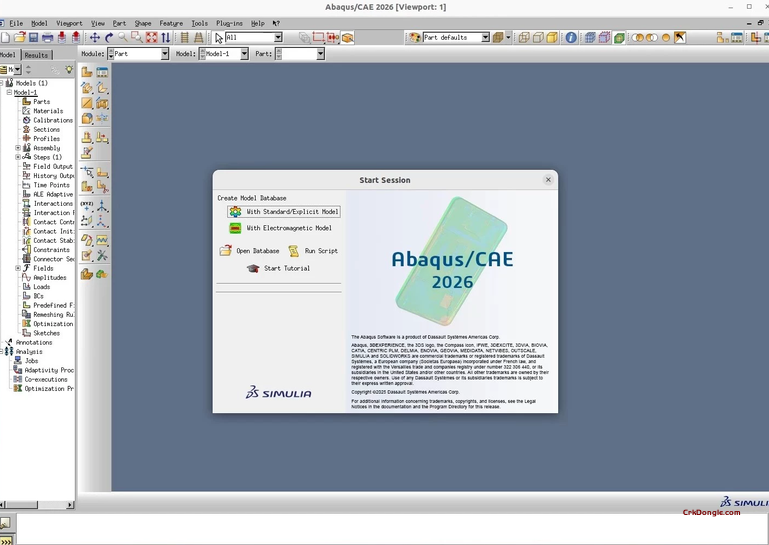
Abaqus 2026 on Linux introduces major performance advancements, particularly through native GPU acceleration for the Abaqus/Explicit solver. This capability is a key feature for high-performance computing (HPC) environments.
Here is an overview of the key new features, system requirements, and how to get started.
🚀 Key New Features in Abaqus 2026 for Linux
GPU Acceleration in Abaqus/Explicit
The most significant update is the native GPU acceleration for the Abaqus/Explicit solver, available as part of the R2026x FD01 release. This makes Abaqus one of the first major commercial explicit FEA codes to leverage GPU computing natively. The feature is designed for Linux systems with NVIDIA GPUs and supports both dynamic and quasi-static analyses, making it suitable for:
-
Crash simulations
-
Drop tests
-
Metal forming
-
Explosion simulations
Important Notes on GPU Acceleration:
-
Performance Gains: The highest speedups are seen in large, element-dominated models (e.g., e10, e11). Contact-heavy problems (e.g., crash simulations) show moderate speedups, while mixed physics models benefit significantly with one to two GPUs.
-
Limitations: GPU acceleration for Abaqus/Explicit currently does not support user subroutines, CEL (Coupled Eulerian-Lagrangian), ALE (Arbitrary Lagrangian-Eulerian), or particle methods.
GPU Acceleration in Abaqus/Standard
Beyond the Explicit solver, the multi-GPU AMG (Algebraic Multi-Grid) iterative solver for Abaqus/Standard has been further optimized in the R2026x FD03 release. This significantly improves the performance and scalability of large-scale simulations on systems with multiple NVIDIA GPUs. Benchmarks on models with up to 51 million DOFs showed notable reductions in solver time when using 4x H100 GPUs.