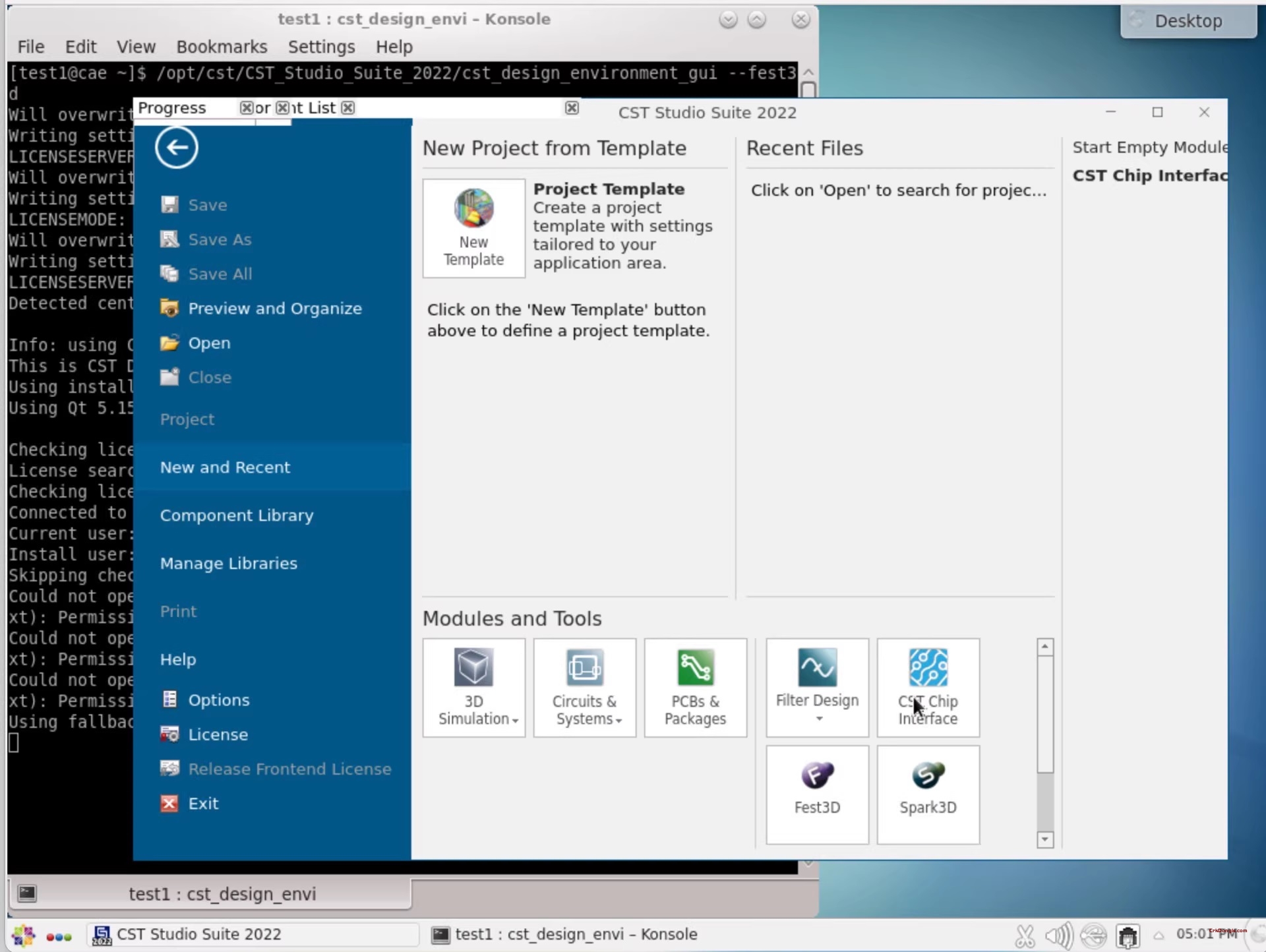
CST Studio Suite 2025 for Linux: High-Performance EM Simulation on Open Systems
CST Studio Suite 2025 for Linux is the Linux-native version of the premier integrated platform for 3D electromagnetic (EM) simulation and multi-physics analysis. It provides engineers and researchers with a full suite of solvers and tools to design, analyze, and optimize electromagnetic devices—from antennas, filters, and on-chip components to entire systems—leveraging the stability and computing power of Linux-based workstations and high-performance computing (HPC) clusters.
Core Function: A Unified Workflow for Complex EM Challenges on Linux
The suite’s primary strength is its unified environment that integrates multiple specialized solvers (eigenmode, transient, frequency domain) within a single interface. This allows users to choose the best numerical method for their specific problem, whether it’s analyzing resonant structures, wideband responses, or full-wave scattering, all within a cohesive Linux-native application.
Key Solvers & Application Areas:
1. Comprehensive Solver Technology
-
Transient Solver: Ideal for wideband analysis, EMC/EMI, and general-purpose 3D EM simulations.
-
Frequency Domain Solver: Efficient for narrowband and resonant structures like filters and cavities.
-
Integral Equation Solver: Optimized for large-scale radiation and scattering problems (e.g., antenna placement).
-
Asymptotic & Specialized Solvers: For high-frequency and large-structure analysis.
2. Key Application Workflows
-
Antenna & Array Design: Full-wave simulation of radiation patterns, impedance matching, and array performance.
-
EMC/EMI & Signal/Power Integrity (SI/PI): Analyze crosstalk, shielding effectiveness, and power delivery network performance in PCBs and electronic packages.
-
RF & Microwave Component Design: Model filters, couplers, waveguides, and connectors.
-
Multi-Physics Coupling: Co-simulate with thermal and structural solvers for effects like antenna detuning or high-power heating.
3. Linux-Specific Advantages & Integration
-
HPC & Cluster Support: Native support for running distributed simulations on Linux-based HPC clusters to solve extremely large problems.
-
Stability & Scripting: Leverages the stability of Linux for long-running simulations and supports extensive automation via Python and VBA scripting directly in the Linux environment.
-
Native Performance: Compiled and optimized for Linux, ensuring efficient use of system resources.