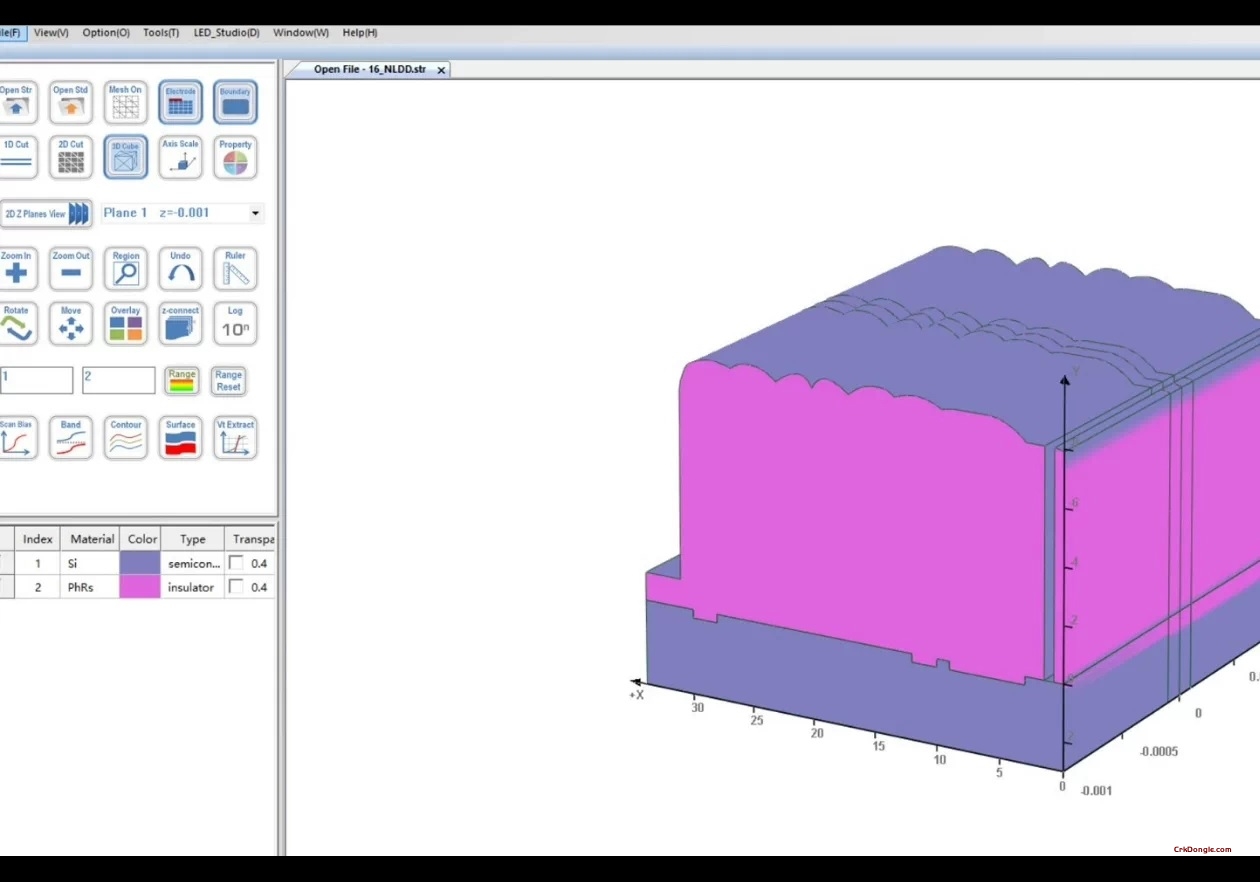
Crosslight CSUPREM 2025: The Integrated TCAD Platform for Semiconductor Innovation
Crosslight CSUPREM 2025 is an advanced Technology Computer-Aided Design (TCAD) software suite that combines powerful process and device simulation tools. It enables semiconductor engineers and researchers to virtually fabricate and characterize integrated circuits (ICs), power devices, and optoelectronic components (like LEDs and lasers). By modeling the complex physical and chemical interactions during manufacturing and subsequent electrical behavior, it provides critical insights for process development, device optimization, and failure analysis.
Core Function: Virtual Semiconductor Fabrication & Characterization
The suite’s primary function is to create a digital twin of the semiconductor manufacturing process and predict the resulting device’s electrical and optical performance. Engineers define a sequence of process steps (implantation, deposition, etching, annealing), and the software calculates the resulting dopant profiles, material structures, and stress distributions. This structural output is then directly used for simulating current-voltage (I-V), capacitance-voltage (C-V), and other key device characteristics.
Key Integrated Modules & Simulation Capabilities:
1. Process Simulation (CSUPREM)
-
Ion Implantation & Diffusion: Accurately models the introduction and thermal redistribution of dopants (boron, phosphorus, arsenic) in silicon and compound semiconductors.
-
Oxidation & Epitaxy: Simulates silicon dioxide growth and epitaxial layer deposition.
-
Etching & Deposition: Models pattern transfer through etching and material deposition steps.
-
Stress & Defect Modeling: Accounts for mechanical stress and point defects generated during processing, which critically affect device performance and reliability.
2. Device Simulation (Crosslight APSYS / LASTIP)
-
Electrical Characterization: Solves the semiconductor equations (Poisson, carrier continuity) to simulate the DC and AC electrical behavior of transistors, diodes, and other devices.
-
Optoelectronic Device Simulation: Specialized modules (LASTIP for lasers, APSYS for general optoelectronics) model light generation, absorption, and waveguiding in LEDs, laser diodes, photodetectors, and solar cells.
-
Thermal & Quantum Effects: Includes self-heating effects and quantum mechanical models for nanoscale devices.
3. Workflow Integration & Calibration
-
Seamless Process-to-Device Flow: The output from the process simulator (the device structure and doping profiles) is automatically prepared as input for the device simulator, ensuring a consistent and accurate workflow.
-
Model Calibration: Supports calibration of physical models against experimental data to improve prediction accuracy for specific fabrication lines or technologies.