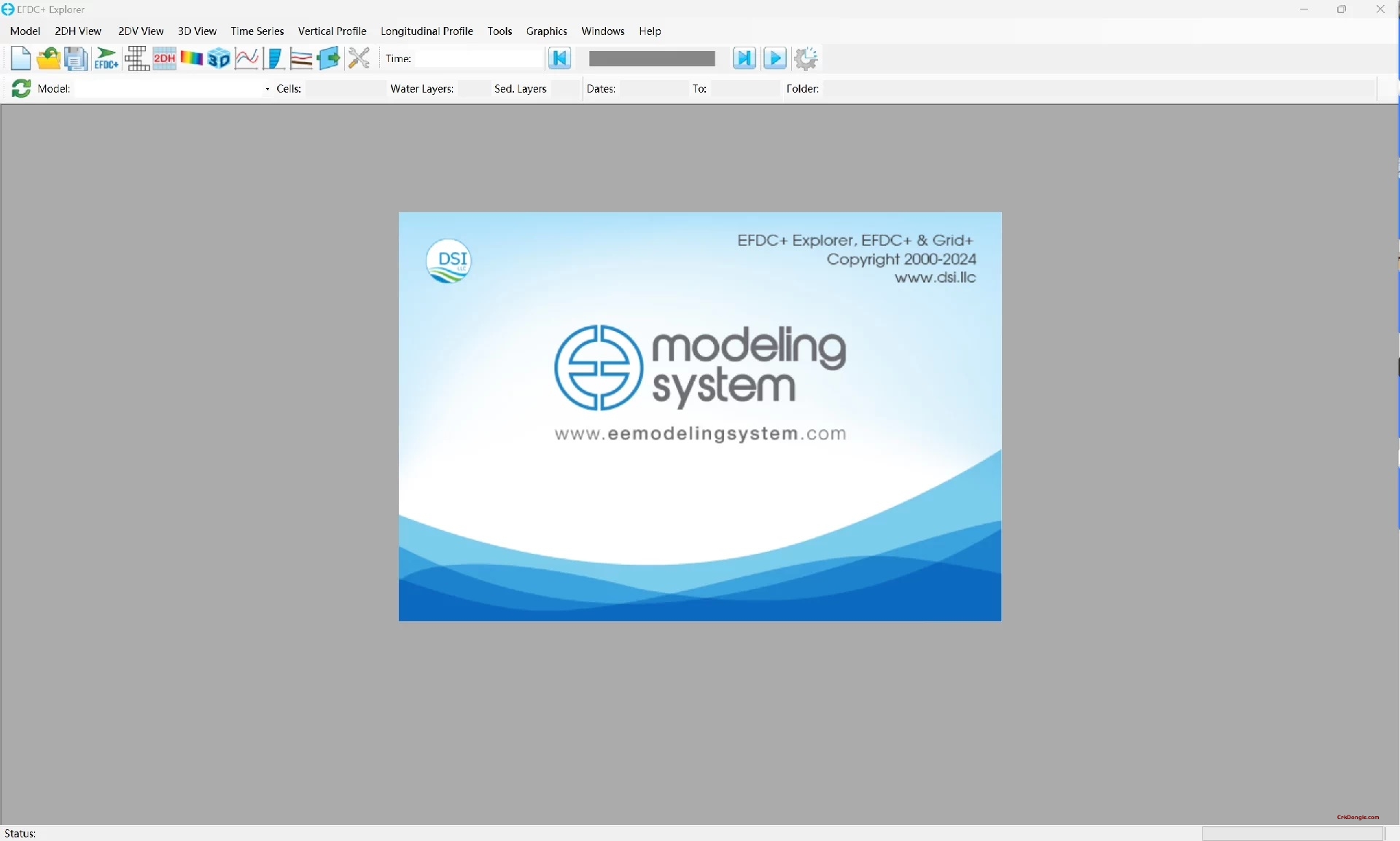
DSI EFDC+ EEMS 12.1: The Integrated Framework for Aquatic Ecosystem Simulation
DSI EFDC+ EEMS 12.1 represents the latest evolution of the Environmental Fluid Dynamics Code Plus (EFDC+), delivered through the Environmental Modeling Surface (EEMS), a powerful graphical pre- and post-processing interface. This integrated suite is the premier tool for conducting sophisticated three-dimensional simulations of the physical, chemical, and biological processes in surface water systems. Trusted by environmental engineers, regulatory agencies, and researchers worldwide, it is designed to tackle complex problems in rivers, lakes, reservoirs, wetlands, estuaries, and coastal waters, supporting critical decisions in environmental management, restoration, and regulatory compliance.
Core Philosophy: A Unified Multi-Physics Modeling Environment
EEMS serves as the central hub that unites the robust computational engine of EFDC+ with intuitive data visualization and management tools. The EFDC+ solver is a state-of-the-art model that simulates hydrodynamics (flow and transport), coupled with a wide array of water quality, sediment, and ecological processes. EEMS 12.1 streamlines the entire workflow—from building the model grid and specifying boundary conditions to running simulations and interactively analyzing multidimensional results—within a single, user-friendly software environment.
Key Modules & Modeling Capabilities:
1. Core 3D Hydrodynamic & Transport Engine
-
Hydrodynamic Simulation: Solves the three-dimensional, vertically hydrostatic, free surface, turbulent averaged equations of motion for water flow, driven by winds, tides, inflows/outflows, density gradients, and Coriolis forces.
-
Scalar Transport: Accurately models the advection, diffusion, and dispersion of conservative substances (e.g., salinity, temperature, passive tracers) throughout the water body.
2. Comprehensive Water Quality & Eutrophication Modeling
-
Advanced Water Quality Module: Simulates the complex interactions of nutrients (nitrogen, phosphorus), phytoplankton (algae), dissolved oxygen, organic matter, and pathogens. This is essential for studying eutrophication, harmful algal blooms, and hypoxia (low oxygen conditions).
-
Contaminant Fate & Transport: Models the behavior of toxicants, metals, and emerging contaminants, including processes like sorption to sediments, volatilization, and degradation.
3. Sediment Dynamics & Morphological Change
-
Cohesive & Non-Cohesive Sediment Transport: Simulates erosion, deposition, settling, and resuspension of multiple sediment classes, enabling studies on turbidity, sedimentation in reservoirs/navigation channels, and habitat suitability.
-
Bed Morphology Evolution: Couples sediment transport with bed level change to predict long-term geomorphic evolution.
4. Powerful Pre- & Post-Processing in EEMS
-
Flexible Grid Generation: Supports the creation of curvilinear, rectilinear, and telescoping grids that conform to complex shorelines and bathymetry.
-
Dynamic Data Visualization: Provides advanced tools for creating time-series plots, 2D/3D contour maps, velocity vector plots, and animated videos of model results, making complex data intuitively understandable.
-
Model Calibration & Validation Tools: Includes features to easily compare model outputs against field monitoring data, facilitating robust model tuning.