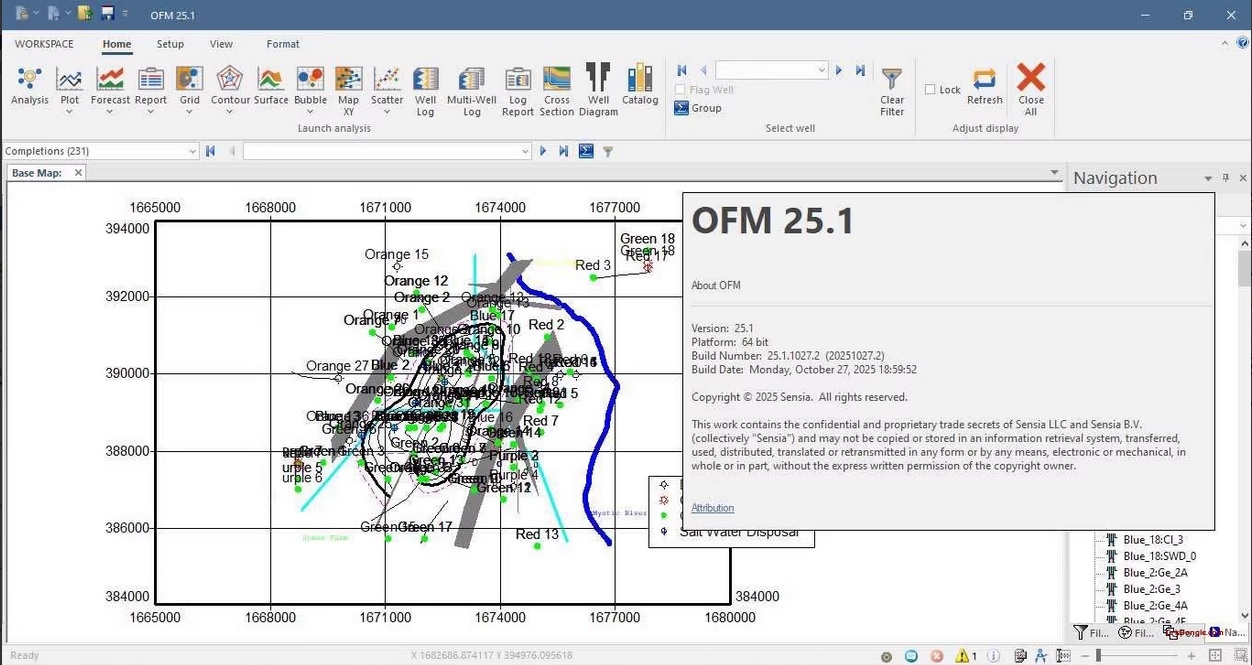
Schlumberger OFM 2025 (Oil Field Manager, now under Sensia/SLB) is the powerful well and reservoir analysis software for production surveillance, performance optimization, and data-driven decision-making in oil and gas fields. The 2025 release (including updates like 25.1) emphasizes a 64-bit architecture for handling large datasets, new visualization tools, performance boosts, and enhanced usability to support engineers in analyzing production/injection data, decline curve analysis (DCA), forecasting, mapping, and custom workflows. OFM integrates seamlessly with tools like Petrel, Peep, and SQL databases for end-to-end field management, turning raw data into actionable insights for improved recovery and operational efficiency.
Key Features of Schlumberger OFM 2025
- Performance and Database Enhancements: Transition to fully 64-bit application; new SQL performance options for faster queries; Autosave feature to protect work during analysis; support for two Azure Active Directory (AD) authentication methods for secure SQL Server connections.
- New Well Log Viewer and File Management: Dedicated Well Log Viewer in the Analysis Dashboard for detailed log interpretation, multi-well comparisons, and log report formats; new File (PDF) Manager & Viewer with tabs for batch/single import and deletion to organize supporting documentation.
- Mapping, Charting, and Export Improvements: Valuable additions to mapping tools (e.g., enhanced layers for OOIP, PV, HCPV, MPV calculations); upgraded charting for better visualization; streamlined export options for reports, data sharing, and integration.
- Dashboard and Catalog Updates: Catalog now supports Dashboard templates; includes ten new standard Dashboard templates; new template export manager for sharing Classic and Dashboard templates across teams.
- Plug-in Development Tools: New Visual Studio Extensions with templates to simplify creation of custom OFM functions and analysis plug-ins, accelerating workflow customization.
- Core Analysis and Visualization: User-friendly interface for ad-hoc analysis; interactive dashboards; decline curve forecasting (Arps and advanced methods); type well analysis (P10-P50-P90, PAvg, PEv curves); waterflood pattern management; geospatial mapping with GIS technology.
- Integration and Data Connectivity: Seamless links to production data sources, simulation models (Petrel), economic evaluations (Peep plug-in), and corporate databases; enables turning raw data into actionable insights for field performance.