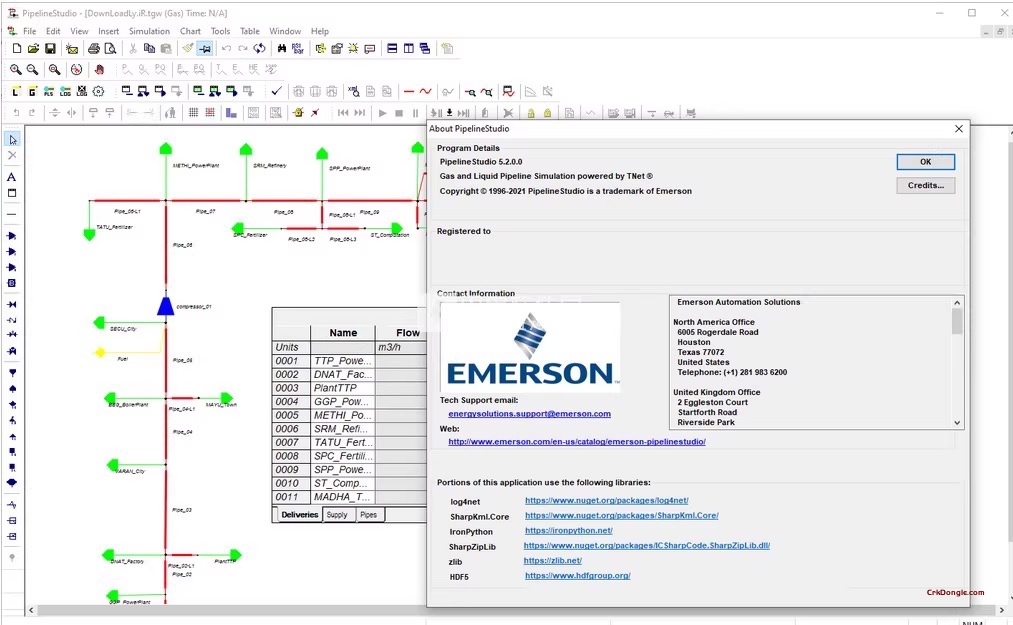
ESI PipelineStudio 5.2 is a comprehensive engineering solution for the design, planning, and simulation of gas and liquid pipeline systems . It combines powerful, industry-validated simulation engines with an intuitive graphical interface, enabling engineers to perform steady-state and transient analyses for a wide range of pipeline scenarios .
Core Capabilities & Features
PipelineStudio is used globally by pipeline operators and engineering firms for its robust analysis tools. Its core capabilities include:
-
Comprehensive Pipeline Modeling: Perform detailed design, sizing, and routing of pipeline networks. It allows for the evaluation of capacity, compression requirements, fuel consumption, and storage needs .
-
Advanced Transient & Steady-State Simulation: Model both stable operating conditions and dynamic events such as surge analysis, line packing, and unpacking. This is crucial for understanding pipeline behavior under changing conditions .
-
Operational & Business Planning: Assess the impact of planned and unplanned operational changes, evaluate pipeline reversal scenarios, conduct “what-if” analyses, and support strategic business and contingency planning .
-
Risk & Integrity Assessment: Identify potential pressure losses, calculate energy savings from reduced pumping costs, and perform critical survival time studies and risk assessments .
Key New Features in Version 5.2
This update introduced several new features and enhancements to improve simulation accuracy and flexibility :
-
Multi-Fluid Configuration: Allows different types of fluids to be included within the same pipeline configuration for both gas and liquid simulations.
-
Enhanced Equation of State (EOS): Added the CNGA (California Natural Gas Association) and VDW (Van der Waals) equations of state for more accurate thermodynamic property calculations.
-
Improved Thermal Modeling: Enhanced calculations for temperature changes across throttling devices, specifically improving the modeling of the Joule-Thomson effect in gas pipelines.
-
Precision & Defaults: Reduced the minimum junction spacing validation to 1 foot for more granular modeling and changed the default setting for liquid regulators to “Check” and “Free Flow” to “Yes” for more realistic default behavior.
-
DRA Updates: Included updates to Drag Reducing Agent (DRA) units for improved liquid pipeline simulation.