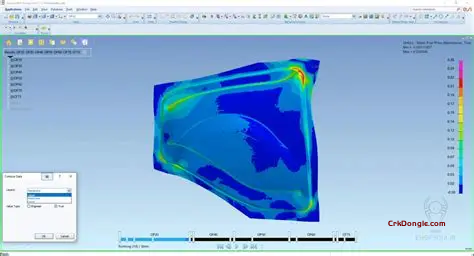
ESI BM-Stamp 2026 | Specialized Stamping Simulation Software for Automotive Manufacturing
ESI BM-Stamp 2026 represents the latest advancement in sheet metal forming simulation technology, specifically tailored for critical automotive stamping processes . As part of ESI Group’s comprehensive virtual prototyping portfolio (now under Keysight Technologies), this software addresses the unique challenges of modern automotive manufacturing, including high-strength steel forming, multi-stage tooling validation, and hot stamping applications .
Core Functionality Overview:
-
Purpose-Built Automotive Stamping Focus: Specifically designed for key automotive stamping processes including single-action tryout, multi-stage tooling, warm forming, and hot stamping (press hardening) operations .
-
Intuitive User Interface & Simplified Workflow: Features a completely redesigned graphical user interface with streamlined operation setup, enabling engineers to more intuitively configure multi-stage and complex sheet metal forming sequences .
-
Complete PAM-STAMP Compatibility: Fully compatible with ESI PAM-STAMP’s extensive material libraries and calculation capabilities, allowing seamless integration with existing stamping simulation ecosystems while benefiting from simplified operation .
-
Advanced Defect Prediction Capabilities: Excels at identifying surface defects on Class A automotive panels during feasibility analysis, and addresses critical challenges of edge cracking and excessive springback in high-strength steel forming applications .
-
Specialized Optimization Modules:
-
Mat-Wizard: Dedicated tool for material characterization and parameter identification
-
Springback Compensation: Advanced algorithms for predicting and compensating elastic recovery
-
Blank Nesting Optimization: Automated tools for optimizing blank shape and material utilization
-
-
Comprehensive Training & Application Support: Supported by structured training programs covering single-action setup, multi-stage process configuration, springback theory and compensation optimization, and double-action forming simulations .